
Understanding exchange funds, capital gains taxes, and whether the tradeoffs fit your life.
Imagine you’ve accumulated $2 million in Google stock.
It started with your initial RSU grant. Then came the refreshers, year after year. More shares vested, you held on to them, and their value grew.
Over a long tenure at Google, those stock awards can become a substantial part of your wealth.
Now you’re thinking about what comes next.
Maybe you want to make work optional. Buy a home. Or simply feel more comfortable having less of your financial future tied to the same company that provides your paycheck.
But selling could mean a substantial tax bill.
So you keep holding. And a decision you’ve been meaning to make gets pushed back another year.
A different way to diversify
I’ve worked with Googlers since 2008, and this conversation comes up often. You’d like to spread some of that wealth beyond Google, but the tax bill makes you hesitate.
That’s understandable. And there may be another option worth considering.
It’s called an exchange fund.
Here’s the basic idea:
You contribute eligible Google shares to an investment partnership. Other investors contribute shares of different companies, perhaps Apple or Microsoft.
In return, you receive an ownership interest in the fund’s pooled portfolio. You give up direct ownership of the shares you contributed and gain exposure to a broader collection of investments.
Under Section 721 of the Internal Revenue Code, a qualifying contribution may defer recognition of your capital gain. Important exceptions and partnership requirements apply. Your existing tax basis generally carries into your partnership interest.
The key word is defer.
You’re potentially postponing the tax. The gain hasn’t disappeared.
For a Googler, there’s another distinction worth understanding. Receiving shares through RSUs doesn’t mean those shares have a zero tax basis. The value included in your compensation when the shares are delivered generally establishes their basis. Subsequent appreciation is a separate part of the tax picture.
Let’s use a hypothetical example:
- Current Google stock value: $2,000,000
- Combined tax basis of the shares: $300,000
- Unrealized capital gain: $1,700,000
Assume the entire gain qualifies for long-term treatment and is subject to a 20% federal capital gains rate plus the 3.8% net investment income tax. Under those assumptions, selling would produce an illustrative federal tax bill of $404,600.
Your actual tax bill would depend on your income and circumstances. State taxes could add to it.
That’s enough money to deserve a thoughtful conversation.
But the potential tax bill is only part of the decision.
What are you giving up in return?
I’d focus on three things.
First, access to your money.
Seven years matters under partnership tax rules for certain distributions. It isn’t a universal promise that your money becomes freely available or tax-free at that point.
Withdrawal terms depend on the fund. Earlier distributions can have tax consequences, and qualifying distributions of securities may preserve deferral beyond seven years. Selling those securities later can produce taxable gains.
If you’re counting on this money for a home purchase or living expenses in three years, those restrictions deserve your attention before the tax benefit does.
Second, what you’ll actually own.
A portfolio containing more companies may still have substantial exposure to technology.
I’d want to understand how much diversification you’re getting, what other assets the fund holds, and
how those investments could behave together. Some funds include less-liquid assets, such as real estate, which introduce their own risks.
You also give up control over the individual investment decisions.
Third, the full cost and complexity.
Management fees, operating expenses, and tax preparation costs can affect the outcome.
Partnership reporting generally includes a Schedule K-1, and investors may receive taxable allocations of income or gains while invested.
The fund’s offering documents need to answer the practical questions. Are your shares accepted? Do you qualify? What can you withdraw, when, and at what cost?
Those details belong in the comparison with simply selling shares and reinvesting the proceeds.
Start with what the money needs to do
Google stock may have helped you build substantial wealth. But there can be some uncomfortable stretches along the way.
The chart below shows how far Alphabet’s total return fell below its previous peak during the displayed period. At its deepest point, the decline was approximately 44%.
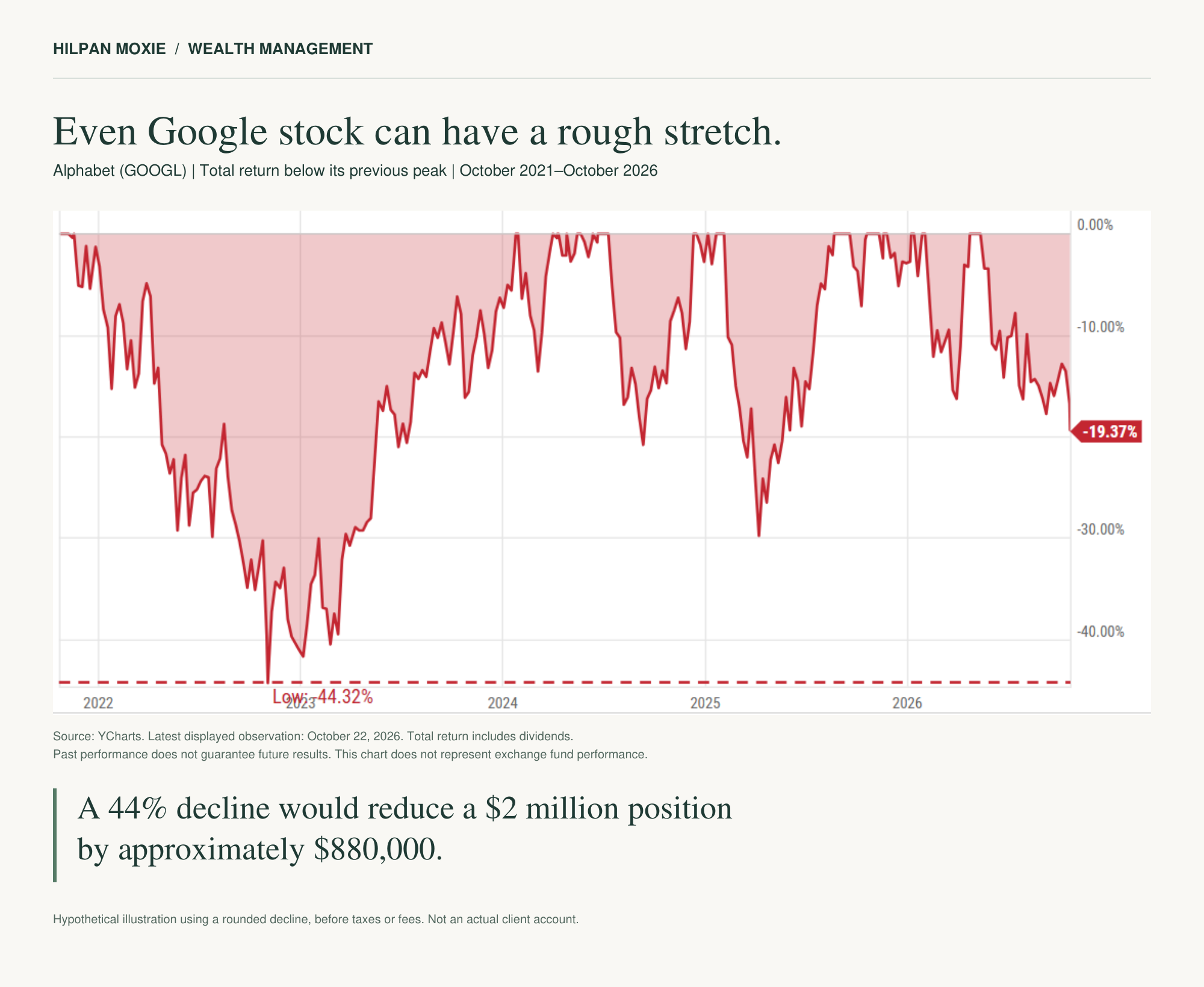
That’s why I bring the conversation back to timing. If you need money while Google stock is down substantially, the tax bill may no longer be your biggest concern.
An exchange fund also remains exposed to investment losses. Diversifying changes the mix of risks you’re taking; it doesn’t remove the possibility of a downturn.
Let’s say you’re 48.
You’ve accumulated $3 million in Google stock, have additional retirement savings, and would like the option to stop working in your early 50s.
Before looking at an exchange fund, I’d want to know how you’ll cover your expenses if you leave Google.
Where will the money come from? What major purchases are ahead? How much flexibility do you want if your plans change?
If most of your available wealth is in those Google shares, putting a substantial amount into a restricted investment could make that transition harder.
If you have sufficient cash and other investments to support the next several years, the conversation looks different. You may have room to consider a longer-term strategy with part of the position.
You don’t necessarily have to make one decision for every share.
Some might support near-term spending. Some might be sold gradually. Some might remain invested in Google. An exchange fund could deserve consideration for a portion you won’t need for a long time.
The allocation should follow the plan.
I’d also compare the fund with other approaches, including spreading sales across tax years, using available investment losses to offset gains, or donating appreciated shares when charitable giving is already part of your intentions.
Each has its own requirements and limitations. Sometimes paying the tax and moving forward gives you the flexibility you’re looking for.
Google stock may have helped create choices you didn’t have earlier in your career. That’s worth acknowledging.
Now it’s reasonable to ask:
If you didn’t already own this much Google stock, would you choose to buy the same amount today?
Your answer doesn’t have to lead to selling everything tomorrow. But it can help you decide whether the position still fits.
You’ve spent years building this wealth. What would you like it to make possible now?
Continue Learning
Explore more perspectives on Google RSUs, concentrated stock, taxes, and work optionality in Hilpan Moxie Insights.
Schedule a Conversation
If you’re wondering how these choices fit your situation, you’re welcome to schedule an introductory conversation.
We can start with what you’ve accumulated, when you might need it, and what you’d like the next chapter to look like.
This content is for educational and informational purposes only and should not be considered personalized investment, tax, or legal advice. Each situation is unique and should be evaluated individually.

Founder, Financial Advisor