
The three numbers you need before you decide anything: your annual spending, your concentration percentage (Google holdings divided by total invested assets), and your first-year withdrawal rate (annual spending divided by total invested assets). Everything else here builds on them.
Who this is for:
Google employees with 10+ years of tenure and roughly $2 million or more in vested RSUs and retirement assets, considering retirement, a career break, or a lower-paying second act.
Who it isn't for:
Employees early in their tenure with mostly unvested equity, or anyone whose main question is how to evaluate a job offer elsewhere.
Key Takeaways
- Start with what your life costs. A $5 million portfolio supports a $120,000 lifestyle very differently than a $300,000 one.
- Test whether your plan works without the Google stock. If it does, the shares are optional.
- Sell for a reason, not a percentage. Ask what the shares are supposed to pay for.
- Cover the first few years of withdrawals with predictable assets, so a market drop right after you leave doesn't force stock sales.
- A lower-income year can open a Roth conversion window, and paying the tax with Google shares does two jobs at once.
This guide covers standard U.S. RSUs and federal tax rules as of October 2026. Your grant agreements and tax situation decide what applies to you.
1. Know Your Number, Then Test the Stock
Short answer: Your spending decides how much the Google stock matters.
You've worked at Google for ~15 years, your RSUs have vested, and you may have several million dollars invested. So: can you afford to leave?
I've worked with Google employees since 2008, and my first question isn't about stock. It's what tomorrow looks like if you no longer report to work, and what that life costs.
Some people want to retire, start a business, or work fewer hours. Others just want to know they could leave. I call that work optionality.
Find your burn rate
Burn rate is what it costs to live your life.
People often think they spend less than their statements show, so pull the last 12 months of bank and card statements, total every debit, and divide by 12.
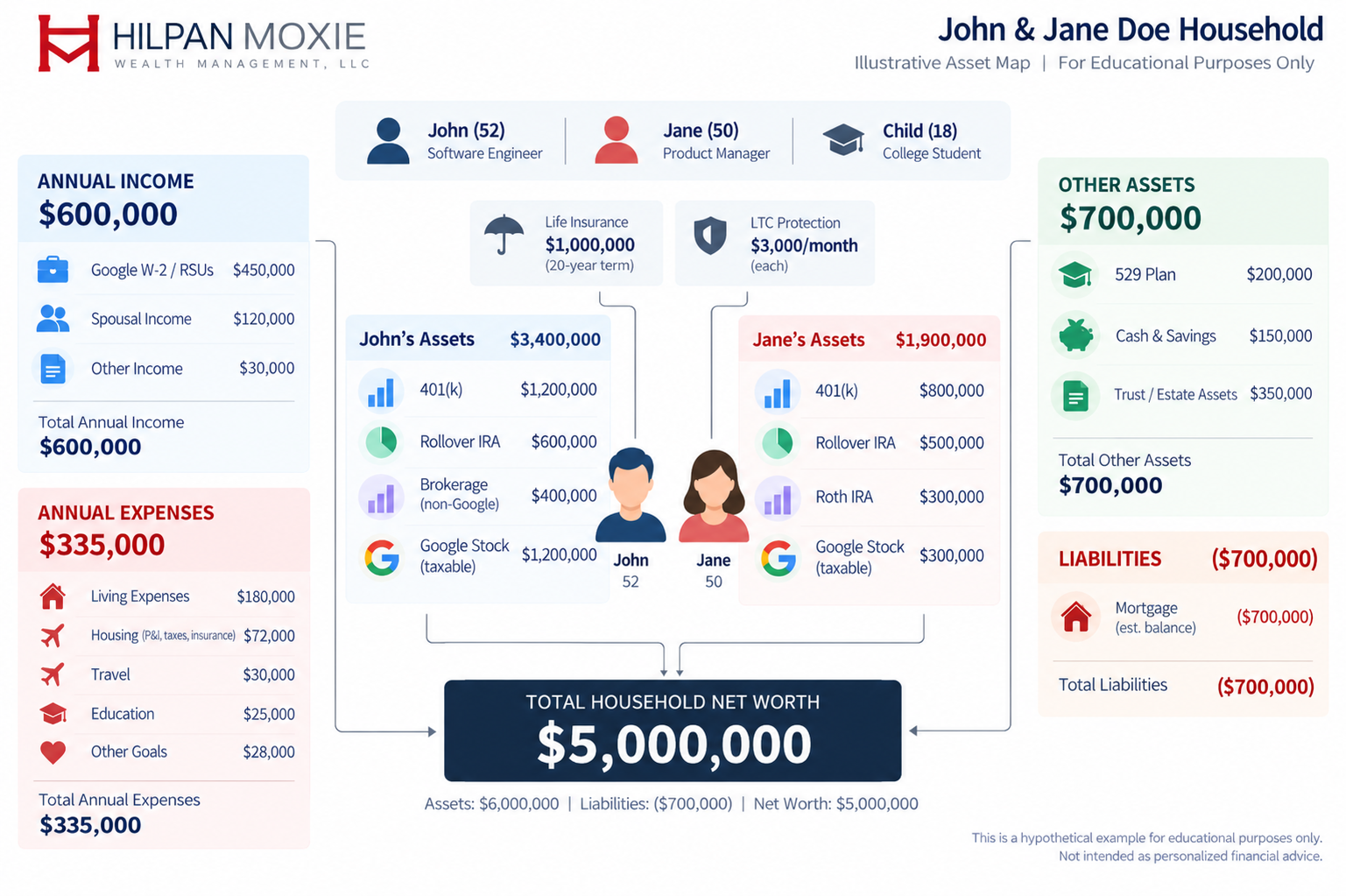
Here are two hypothetical households, each with $5 million invested.
Household A
- Investments: $5,000,000
- Monthly spending: $10,000
- Annual spending: $120,000
- Initial withdrawal rate: 2.4%
Household B
- Investments: $5,000,000
- Monthly spending: $25,000
- Annual spending: $300,000
- Initial withdrawal rate: 6.0%
Same $5 million portfolio. Two very different retirement conversations.
As a reference point, a household spending $10,000 a month might hold six months, or $60,000, in reserve, depending on job security and family obligations.
Then set the Google stock aside
Look at everything else: your 401(k), IRAs, and diversified brokerage accounts. Can a reasonable retirement plan work on those alone?
Sometimes it can. When it does, I call the Google stock gravy on top.
The plan doesn't depend on Alphabet's share price to cover essential spending, so you have more flexibility in deciding how much to keep. The concentration still carries risk, and you should decide on purpose whether that risk is appropriate.
When the plan can't work without the shares, decide how much of the position is assigned to real financial needs. That's a better starting point than reflexively reducing every concentrated position to 5%.
2. Should You Sell Your Google Stock?
Short answer: Sell for a reason, not a percentage.
"Don, should I sell Google?"
My first reaction is often: why not? But I want to know what's behind the question. A house? College? Retirement? Lower risk? Each can lead to a different answer.
Know what you're holding
Longtime employees didn't decide one day to buy $1.5 million of Alphabet stock. They accumulated it through years of RSU vesting and refreshers.
A simplified four-year award might vest 25% a year, and overlapping refreshers stack several schedules together. Actual awards vary and refreshers aren't guaranteed, so your grant agreements control.
Vested shares are now part of your portfolio, and holding them means accepting Alphabet's stock-specific risk.
How much risk are you taking?
Take a $5 million portfolio with $1.5 million in Alphabet: 30% in one company.
If you still work at Google, the same company also pays your salary and future equity.
A 40% drop in the stock is a $600,000 loss. Could your household absorb that without changing its plans? What if you plan to buy a home or leave within two years?
This isn't a forecast. It tests whether your goals depend too heavily on one stock.
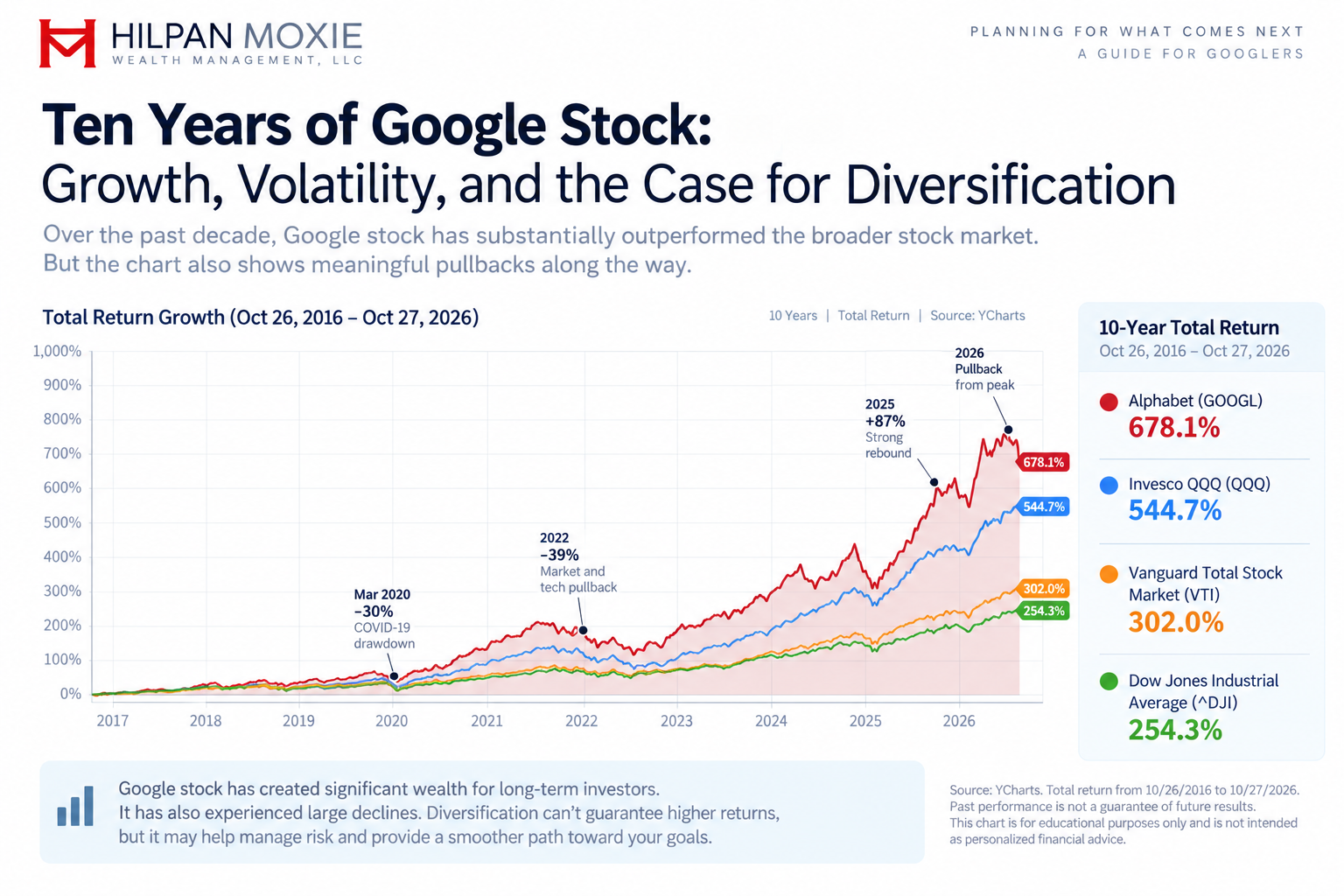
Waiting doesn't remove the risk. If the stock keeps rising and RSUs keep vesting, the position and its unrealized gains both grow, leaving a larger concentration and a harder tax decision.
The stock could also fall. A deliberate plan beats open-ended delay, and I'd write it down in an investment policy statement: a written understanding of how your investments should be managed and why.
RSU income versus capital gains
For standard U.S. RSUs, the value of shares delivered at vesting is generally ordinary compensation income, and that amount generally becomes your tax basis. Later gains or losses are measured against it.
- You receive 1,000 shares vesting at $200: generally $200,000 of compensation income.
- You sell at $240: the extra $40,000 is generally a capital gain.
- You sell at $160: you'd generally have a $40,000 capital loss, subject to the tax rules.
Shares withheld at vesting are a payment toward your taxes, not always the amount you'll owe.
Get the full-year income picture, and your CPA involved, before significant sales.
What the proceeds can do
Selling can accomplish something specific while reducing concentration: paying down a mortgage, funding a 529 plan, or setting up several years of planned withdrawals in more predictable investments.
Weigh the capital gains and whether the use of funds makes sense.
Before scheduling any sale, check your trading-window dates and any pre-clearance requirement in Alphabet's insider trading policy for your role. Current employees must also avoid trading on material nonpublic information.
3. Can You Get to the Money?
Short answer: Leaving in your early 50s can create a gap between your last paycheck and your first penalty-free retirement withdrawal, so plan the bridge before you resign.
Most retirement money sits in a 401(k) and traditional IRAs. If you leave at 52, you generally can't take penalty-free distributions from either until age 59 and a half.
Two exceptions matter, and both avoid the 10% penalty, not ordinary income tax:
- The Rule of 55. If you leave an employer in or after the year you turn 55, you can generally take penalty-free distributions from that employer's 401(k). It doesn't apply to IRAs, and rolling the 401(k) into an IRA gives up the exception. It also isn't available if you leave at 52, so your leave date matters.
- Substantially equal periodic payments (72(t)). These allow penalty-free IRA withdrawals before 59 and a half if you follow a fixed schedule for five years or until 59 and a half, whichever is later. Breaking the schedule can trigger retroactive penalties.
Your other bridge sources are taxable brokerage accounts (including vested Google shares), cash reserves, and Roth IRA contributions, which you can generally withdraw at any time without tax or penalty.
Converted amounts can generally be withdrawn penalty-free after five years, with a separate clock for each conversion, which is one reason to start conversions early.
This is why order matters. If you're 52 and 85% of your money is in pre-tax accounts, leaving this year may be harder than a spreadsheet suggests.
Confirm your eligibility with your plan administrator and CPA.
4. Replacing the Paycheck
Short answer: Fund the first few years of withdrawals with predictable assets, so a market drop doesn't force stock sales.
Say you're 52, considering leaving, and earning $400,000 to $500,000 a year (illustrative). Once you leave, that W-2 income may drop sharply. You'll want to know where monthly spending comes from and whether lower-income years open Roth conversion opportunities.
Suppose you need $15,000 a month, or $180,000 a year, from your portfolio. If the market falls 30% shortly after you leave, your expenses don't stop. Funding them only by selling stocks could mean selling at depressed prices.
One approach I use where it fits is a ladder of individual Treasury securities. For example, five Treasuries maturing in consecutive years, each returning about $180,000 of principal, would set aside $900,000 for five years of planned withdrawals.
As each one matures, the proceeds cover that year's spending without an immediate stock sale.
This is a hypothetical that ignores interest, taxes, inflation, and fees. Corporate bonds can extend a ladder but add default risk, and no ladder guarantees stocks will recover within any period.
What unvested shares do to your timing
Leaving usually means giving up unvested RSUs, so your departure date is a financial variable.
The difference between leaving in March and leaving in November can be six figures of compensation.
Before you pick a date, price two things:
1- The next vests. What vests in the next six months, and what is it worth at today's price? Waiting for one vest can be worth more than months of the salary you'd give up.
2- Your award terms. Treatment of unvested awards on departure depends on the grant terms and can differ by award year. Check each grant agreement.
The decision is often "leave in April or leave in December," not "leave now or stay forever."
That's worth running through a spreadsheet before you resign.
5. Leaving Google May Open a Roth Conversion Window
Short answer: A lower-income year can make a conversion cheaper, and Google shares can pay the tax.
A Roth conversion moves money from a pre-tax account into a Roth account, and the taxable portion counts as income that year. Qualified Roth distributions can be tax-free, and Roth IRAs generally have no required minimum distributions during the owner's lifetime.
But while you earn a large Google salary, a conversion can trigger a big tax bill, so I look at conversions when someone leaves a high-paying job or has a meaningful drop in taxable income. Not automatically, though.
If you leave in October, you've earned nine or ten months of salary, several RSU awards may have vested, and you may receive severance. That can still be a high-income year, and the following year may be the better window.
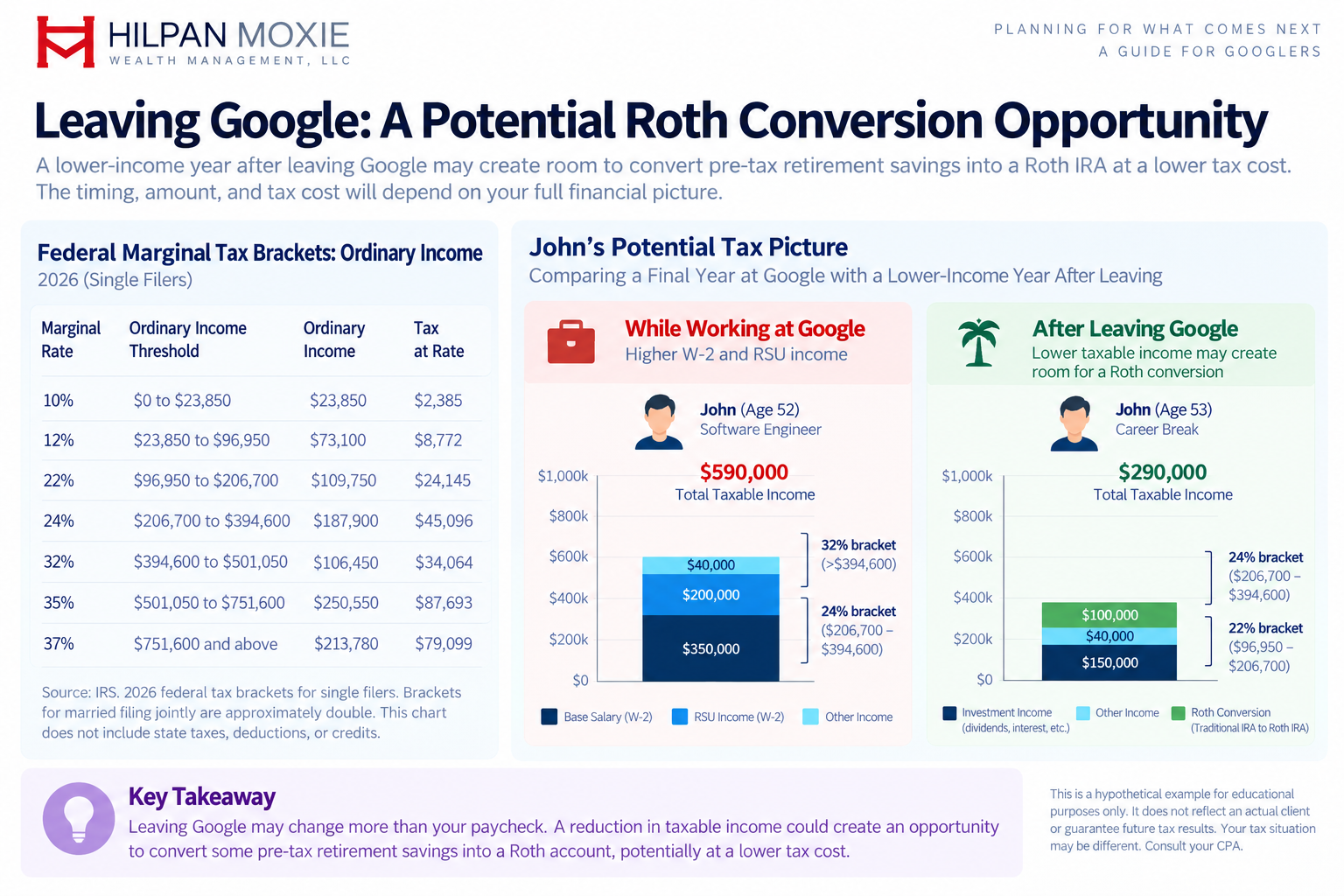
Leaving Google may change more than your paycheck. A reduction in taxable income could create an opportunity to convert some pre-tax retirement savings into a Roth account. The timing, amount, and tax cost still need to be evaluated.
A worked example: paying the conversion tax with Google shares
You want to convert $100,000 from a traditional IRA, and assume it creates an additional $30,000 in federal income tax.
There are two ways to pay:
- A. Withhold from the IRA. $30,000 goes to taxes and $70,000 reaches the Roth.
- B. Pay from outside the IRA. All $100,000 reaches the Roth, and you sell Google shares to cover the tax.
For B, assume you sell $33,000 of Google stock with a $21,000 basis. Assuming a 23.8% federal capital gains tax rate, including the 3.8% net investment income tax, the $12,000 gain would generate approximately $2,856 in taxes.
That leaves roughly $30,144 to pay the $30,000 conversion tax.
Option A: Withhold from IRA
- Gross IRA withdrawal: $100,000
- Reaches the Roth: $70,000
- Google stock sold: $0
- Capital gains tax on sale: $0
- Concentrated position reduced: $0
Option B: Pay with Google shares
- Gross IRA withdrawal: $100,000
- Reaches the Roth: $100,000
- Google stock sold: $33,000
- Capital gains tax on sale: About $2,856
- Concentrated position reduced: $33,000
In Option A, the $30,000 withheld is not converted. If you're under 59 and a half, it may be subject to a 10% early-distribution penalty.
Option B puts $30,000 more into the Roth and reduces the Google position in the same move.
It costs about $2,856 in capital gains tax here, and uses cash that could serve other goals.
Recently vested shares usually have a basis close to today's price, so selling them produces a smaller gain than selling shares from an older grant.
Selling the highest-basis lots first is often the efficient move, but shares held a year or less produce short-term gains taxed at ordinary rates, and it all interacts with your overall gain picture, so confirm with your CPA.
All figures are hypothetical, and your rates will differ. Compare both paths with your CPA before choosing either.
Why I review this in October
By October, you have nine months of pay stubs, a clearer picture of your RSU income, and a better sense of any bonus you may receive.
That's enough to project where your taxable income lands, and it leaves time to adjust withholding or estimated payments before year-end.
Bring your CPA:
- Your last three pay stubs.
- Your year-to-date RSU vest confirmations from your equity portal.
- Your brokerage statements showing dividends, interest, and realized gains.
Then ask three questions:
- 1- What's my projected marginal bracket this year?
- 2- How much room do I have before the next bracket?
- 3- Which lots should I sell to fund the tax?
The bracket matters because converting enough to move from the 24% bracket into the 32% bracket may not be worth the added tax.
For 2026, the 24% bracket covers taxable income of $105,701 to $201,775 for single filers and $211,401 to $403,550 for married filing jointly.
The 32% bracket runs to $256,225 (single) and $512,450 (joint).
The 3.8% net investment income tax generally applies when modified adjusted gross income exceeds $200,000 (single) or $250,000 (joint).
Verify these against current IRS tables before you act.
If a conversion doesn't make sense this year, revisit it next year.
The aim is a repeatable process, not a December scramble.
Before You Make the Call
Short answer: Get your three numbers and your vest schedule before you decide anything.
Pull the last 12 months of bank and card statements and total every debit. That's your annual spending.
Divide your Google holdings by your total invested assets. That's your concentration percentage.
Divide your annual spending by your total invested assets. That's your first-year withdrawal rate.
Log in to your brokerage and your Google equity portal, and write down each unvested grant, its vest dates, and the shares due on each.
Then look at retirement income, taxes, and what should change before you leave.
A spreadsheet can test whether leaving is feasible, but it can't tell you what changed.
Someone who was excited to move from L4 to L5 a few years ago may now face longer hours or different family circumstances, or may simply be tired.
Ask what's changed, because the plan has to account for the answer.
The analysis may show you're ready, or that another year or two would help. Either is useful.
Enough is greater than more, because more is easy to keep chasing.
Enough requires you to decide what matters, and once you've done the work, you can own that decision.
What This Guide Doesn't Cover
State income tax, which varies widely (California and Washington, for example, treat income differently), estate planning, equity awards other than standard RSUs (ISOs, ESPP, deferred compensation), and the emotional side of leaving a job you've held for a decade.
Each deserves its own conversation.
About the Author
Don Hilario, CFP®, is the founder of Hilpan Moxie Wealth Management, LLC. He specializes in working with Google employees on RSU planning, concentrated stock decisions, and the financial complexity of a career at Google.
Important Disclosures
This content is for informational and educational purposes only and should not be considered personalized investment, tax, or legal advice. Each situation is unique and should be evaluated individually.
All numerical examples are hypothetical and do not represent actual client experiences or results. Tax rates and thresholds reflect federal rules as of October 2026 and change over time. Projections depend on assumptions and actual outcomes may differ. Investing involves risk, including possible loss of principal.
Diversification and fixed-income strategies do not guarantee profits, prevent losses, or ensure retirement income needs will be met.
Hilpan Moxie Wealth Management, LLC is an SEC-registered investment adviser. Registration does not imply a particular level of skill or training. References to Google and Google do not imply affiliation with or endorsement by either company.
Hilpan Moxie Wealth Management is not compensated by any firm, platform, or product mentioned in this guide. Nothing here is a recommendation to buy, sell, or hold any security, including Google.
This content is for educational and informational purposes only and should not be considered personalized investment, tax, or legal advice. Each situation is unique and should be evaluated individually.

Founder, Financial Advisor