
Half a million dollars is an extraordinary income. If you're fortunate enough to earn that much, congratulations. I mean that.
But I'm curious. When you think about making $500,000 a year, what comes to mind?
Maybe it's finally buying the house you've had your eye on. Putting more away for retirement. Helping your kids pay for college. Or taking a family vacation without worrying too much about what it costs.
All reasonable things to want.
The challenge, at least from what I've seen working with Google employees, is that money has a lot of jobs. And the cost of being responsible isn't cheap.
The Headline Number Isn't What You Get to Spend
Let's say you're a Google employee earning $500,000 in total annual compensation.
That's your headline number. But chances are, it isn't arriving as $500,000 in regular paychecks.
You might receive a base salary every two weeks, RSUs as they vest throughout the year, and a performance bonus annually. Depending on the stock price and your bonus, the amount you actually receive can change.
Then we have taxes.
If you're living in California or New York, federal and state income taxes can take a meaningful portion of that compensation. You're also contributing to your 401(k), perhaps taking advantage of a Mega Backdoor Roth if your plan allows it, and maybe setting money aside for your children's education.
All good things to consider.
But notice what's happening. Before you've paid the mortgage or taken your family anywhere, you've already given a substantial portion of your income a job.
And we haven't talked about the house yet.
A $500,000 Household With a Lot Going On
Assume that after taxes, payroll deductions, and retirement contributions, they have approximately $21,000 a month available for living expenses. That's an illustrative figure, not a universal take-home-pay estimate. The actual number would depend on how their compensation is structured, where they live, and what they're contributing to their benefits and retirement accounts.
Here's one possible monthly budget.
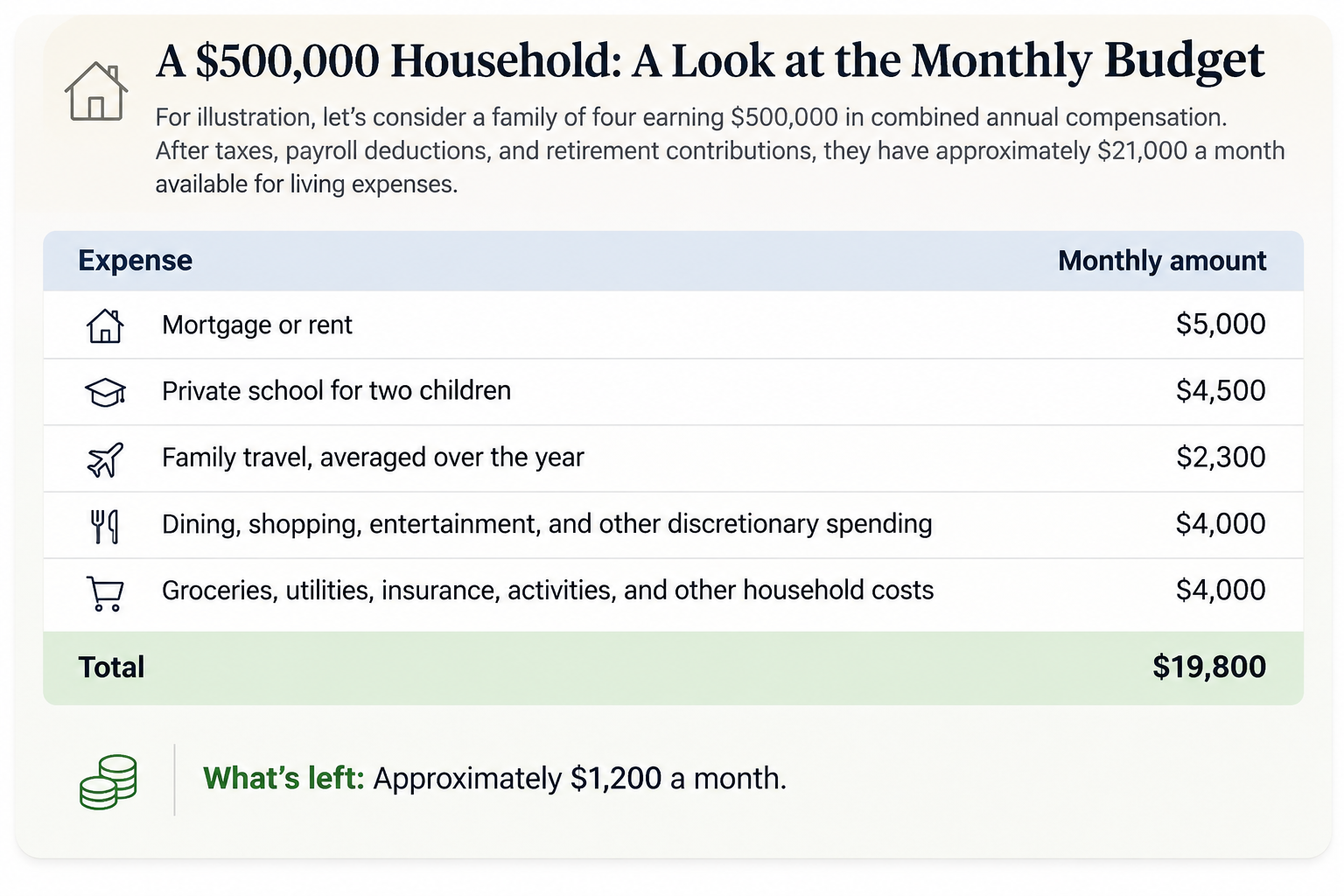
That leaves approximately $1,200 a month.
Now, I can already hear the objection. Four thousand dollars in discretionary spending? More than $27,000 a year for travel?
Fair enough.
Those are substantial lifestyle choices. They're not necessities, and I'm not going to pretend otherwise.
But I also wouldn't automatically tell this family they're spending too much.
Maybe traveling with their children is one of the reasons they've worked so hard. Maybe private school is a priority. Perhaps they love their neighborhood and have no interest in moving.
I'd want to understand those choices before suggesting they change them.
Because the question isn't whether this family can find expenses to cut. Of course they can.
The question is what they're trying to accomplish with their money.
The Cost of Being Responsible
Let's assume this family wants to save more.
They'd like to put another $2,000 a month toward college and $3,000 a month into a taxable investment account. Maybe they want the flexibility to retire early or leave Big Tech before they're eligible to access their retirement accounts without restrictions.
Those are worthwhile goals.
But adding $5,000 in monthly savings to a budget with $1,200 remaining doesn't work without changing something.
That doesn't mean the family is financially failing. They're already contributing to retirement, and those contributions count. It means they've identified more things they'd like their money to do than their current cash flow can comfortably support.
I think this is where the tension shows up for successful savers.
You're doing well. You want to be responsible. You know the benefits of saving early and allowing investments time to grow.
But at what point do you give yourself permission to enjoy more of what you've earned?
I'm a saver by nature, so I understand the impulse to put more away. Still, I don't think maximizing every available savings opportunity should automatically become the goal.
There's a cost to doing that, too.
Maybe it's the vacation you don't take. The house you don't buy. Or the extra years you spend working when you'd rather be doing something else.
That doesn't make saving wrong. It just means we should be clear about what we're trading for it.
What About the $2.5 Million House?
Now let's introduce another possibility.
The family has been looking at a $2.5 million home.
Depending on the down payment, financing terms, property taxes, insurance, and maintenance, owning that house could cost considerably more than their current housing arrangement.
They might qualify for the mortgage. They might have enough vested Google stock to fund the down payment.
Fantastic.
But before we celebrate the lender's approval, I'd want to ask a few questions.
Does the home put them in a school district where private school is no longer necessary? Would they still have room in the budget for the travel they enjoy? How much of the ongoing housing cost would depend on RSUs or bonuses?
And what if one spouse decides to work less five years from now?
I hope they continue earning $500,000 or more for as long as they want. I hope Google stock does exceptionally well.
But I'd also like to understand whether the house still works if their plans change.
Maybe the answer is yes. Maybe they have substantial investments outside their retirement accounts, or they're comfortable making other adjustments.
Then buying the house could be entirely reasonable.
Or maybe they discover that the purchase would make it difficult to leave their current jobs, even if they wanted to.
That's worth knowing before signing up for a large mortgage.
Your RSUs Add Another Layer
One thing I've learned from working with Google employees is that total compensation and spendable cash don't always move together neatly.
RSUs can be an incredible source of wealth. But the timing of vesting, the stock price, withholding, and decisions about whether to sell shares all affect how that compensation turns into usable cash.
A household might look at its W-2 and see an impressive number while its regular paycheck tells a different story.
That doesn't mean vested shares have no value. They absolutely do. Once vested and available for sale, they can provide liquidity, subject to applicable trading restrictions and taxes.
But if you're counting on future equity compensation to cover a mortgage, private school, and recurring living expenses, I think it's worth understanding what happens if that compensation comes in lower than expected.
There's also the question of how much Google stock you've accumulated over the years.
If your salary, future RSUs, and a significant portion of your investments all depend on the same company, that deserves a conversation.
Not because Google is a bad company. Far from it.
But how much of your financial life do you want riding on one company's success?
I don't know the answer for you. I'd first want to know what that stock is supposed to accomplish.
This question comes up in another form when someone asks me whether $5 million is enough to retire.
My first reaction? That's a lot of money. Congratulations.
But then I'd want to know how much it costs you to live.
If your household spends $120,000 a year, we're having a very different conversation than if you're spending $300,000 and that number keeps climbing.
I'd also want to understand what makes up the $5 million. Is it diversified? Is most of it in one stock? How much is readily available if you decide to stop working before traditional retirement age?
The number alone doesn't tell us enough.
And I think the same applies to a $500,000 income.
Some families will be perfectly happy earning that amount, saving aggressively, and keeping their lifestyle relatively modest.
Others will decide that a beautiful home, travel, or private education is worth saving less for a while.
I don't see a problem with either approach, provided the family understands what they're choosing and what those choices might mean later.
What I find more concerning is when people keep pursuing more without ever asking what more is supposed to accomplish.
More income. More investments. More house.
I understand the ambition. I admire it.
But eventually, I think it's worth asking whether you've already built enough to do some of the things you've been putting off.
Maybe it's spending more time with your children. Maybe it's taking a sabbatical, starting a business, or simply working because you enjoy the work rather than because you need the paycheck.
Those possibilities are worth considering, too.
So, Is $500,000 Enough?
It might be.
It might be more than enough for the life you want. Or you might discover that the lifestyle you're building requires more income, different spending choices, or additional years of work.
I'd rather understand that now than make assumptions based on the headline salary.
If you're earning $500,000 and still feeling stretched, I'd start by looking at where the money is going, how much you're already saving, and which goals matter most to you and your family.
Then we can look at the trade-offs.
Perhaps you can buy the house and still retire when you want. Perhaps you'll decide the freedom to leave Google in five years matters more than upgrading your home.
Either way, I hope you get to enjoy the success you've worked hard to build.
Half a million dollars gives you a lot of possibilities.
What do you want that money to do for your life?
I talk more about this question in a short video, including why the headline income doesn't always tell us much about the life it can support.
Watch my short video: Is $500,000 Enough?
Let's Talk About What Your Money Can Do for You
I've spent years working with Google employees on decisions involving RSUs, concentrated stock, retirement, and the trade-offs that come with building substantial wealth.
At Hilpan Moxie Wealth Management, we start by understanding what matters to you. Then we look at the numbers, explore the possibilities, and build a financial plan around the life you want.
If you're wondering whether you're saving enough, enjoying enough, or already in a position to make a change, I'd welcome the conversation.
Book an Intro Call
This content is for educational and informational purposes only and should not be considered personalized investment, tax, or legal advice. Each situation is unique and should be evaluated individually.

Founder, Financial Advisor